Water Damage Cost Calculator
Four questions. It runs on this page and sends nothing anywhere.
On this page
What drives the cost
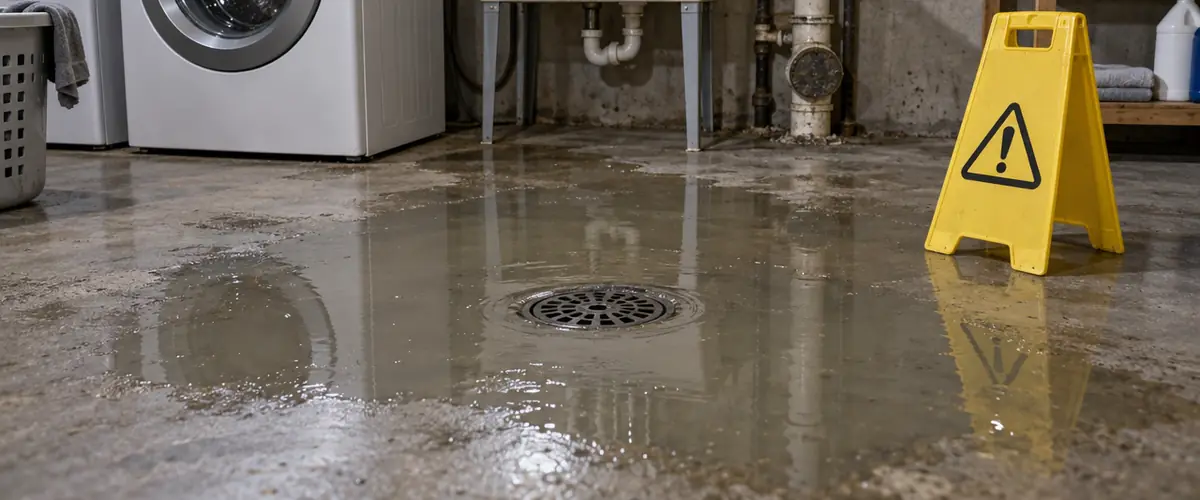
Sewage is Category 3 water, the dirtiest kind. That changes what has to come out and how long drying takes.
-
More comes out
Porous things that sewage soaks can’t be cleaned. Our calculator cuts drywall 4 ft up for sewage, against 2 ft for gray water, and takes out hard floors as well as carpet. One 200 sq ft room costs $4,700–$10,050, against $3,650–$7,850 for gray water.
-
Hard floors cost more
Tearing out and replacing vinyl plank costs more than carpet. The same 500 sq ft basement runs $10,400–$21,900 with hard floors and $8,900–$18,850 with carpet.
-
Cabinets
Base cabinets that sewage soaks are replaced, at $120–$240 per foot before overhead and profit. A 200 sq ft kitchen with a run of cabinets comes to $6,500–$14,200.
-
Finished or not
An unfinished basement with a concrete floor and open walls has little to tear out or rebuild: 500 sq ft runs $2,650–$5,750, mostly cleanup and drying.
Sewage is the most expensive water to clean up
- Category 1 Clean water Burst supply line, clean sink overflow $$$Lowest cost
- Category 2 Gray water Washing machine, dishwasher, aquarium $$$Higher cost
- Category 3 Black water Sewage, sewer backflow, floodwater from outside $$$Highest cost
Cost by situation
Each range is the calculator’s answer for a typical case at national prices, from cleanup through repairs.
-
Small bathroom100 sq ft, tile or vinyl floor and drywall $3,750–$8,100
-
One carpeted room200 sq ft, carpet and drywall $4,700–$10,050
-
Kitchen with cabinets200 sq ft, hard floor, drywall, 10 ft of base cabinets $6,500–$14,200
-
Unfinished basement500 sq ft, concrete floor, open walls $2,650–$5,750
-
Finished basement, carpet500 sq ft, carpet and drywall $8,900–$18,850
-
Finished basement, hard floors500 sq ft, vinyl plank and drywall $10,400–$21,900
Got a quote? Check it line by line
Sewage jobs get lump sums like “biohazard cleanup” that are hard to compare. Upload your quote and we’ll check it line by line.
Water Damage Quote Checker
Upload a PDF or photos. Free, no sign-up.
No quote yet?
By uploading, you agree to our terms and confirm you have the right to share the quote. How we handle uploads
- Every line compared with price sheets near the job
- The questions to ask before you sign
- We never keep the file
Turn on JavaScript to upload a quote.
Reading your quote
- Reading every line
- Sorting drying, equipment and tear-out
- Getting it ready for you to check
We read 0 lines
Check them against your quote and fix anything we got wrong. Nothing is compared until you say it looks right.
When you check it, we keep these lines and the first three digits of the ZIP code to improve our ranges, never the file. Remove any names or addresses first. How we handle uploads
Ask before you sign
We compare drying prices with published price sheets and repair prices with typical local rates, adjusted for labor costs near the job. A line can be high for a good reason, like water hidden in a wall, so ask before you assume.
A fair quote shows
- Category 3, and where the sewage came from
- Which rooms the sewage reached, with square footage
- Drywall cut height and square footage
- Cleanup priced apart from rebuilding
Red flags
- A “biohazard” or “sewage remediation” lump sum with no quantities
- Sewage-grade charges for rooms the sewage never reached
- Being told you have to sign an assignment of benefits
Will insurance pay?
Usually not, unless you added water backup coverage. Standard homeowners policies exclude water that backs up through sewers and drains, and the add-on usually has its own limit.
Usually covered
- Backup through a sewer or drain, with a water backup endorsement
- Sump overflow when the pump fails (not the pump itself), under many backup endorsements
- Backup caused directly by a flood, under flood insurance
Usually not covered
- Backup on a standard policy without the endorsement
- Costs above the endorsement’s limit
- Backup from anything other than a flood, under flood insurance
Check your policy’s declarations page for water backup coverage.Does homeowners insurance cover water damage?
Before the cleanup crew arrives
-
1
Stop using water and drains
Every flush, shower and load of laundry can push more sewage up through the lowest drain.
-
2Safety
Keep people and pets out
Children, older people and anyone with a weakened immune system are at higher risk of getting sick, so keep them away.
-
3Safety
Gear up if you go in
Wear rubber boots, gloves and eye protection, and wash your hands well afterward.
-
4
Photograph it and report it
Call your insurer. If the city’s sewer main caused it, file a claim with the city quickly: New York City allows 90 days, Michigan 45.
Questions people ask
Does homeowners insurance cover a sewage backup?
Not on a standard policy. Sewer backups need their own coverage, bought as an endorsement or a separate policy, the Insurance Information Institute says. The endorsement usually has its own limit; New Jersey’s insurance department says it’s usually $5,000. Flood insurance covers a backup only when a flood directly caused it.
Can I clean up sewage myself?
A small toilet overflow on a tile floor, yes, with rubber boots, gloves and disinfectant. Once sewage soaks into carpet, drywall or furniture, those have to go: the CDC says to throw away items that can’t be disinfected, like wall coverings, rugs and drywall. That tear-out and drying is what the cleanup price covers.
Who pays when the city sewer backs up?
It depends on where the blockage was and on local rules. The homeowner is usually responsible for at least part of the line between the house and the public main; in New York City and Fairfax County, for the whole line, even under the street. If the city’s main caused the backup, you may be able to claim from the city, but deadlines are short: 90 days in New York City, and 45 days from discovering the damage in Michigan, where you also have to show the city knew or should have known about the defect and didn’t fix it in reasonable time.
What causes sewer backups?
Grease, wipes and other things that shouldn’t be flushed, tree roots growing into the line, and heavy rain overloading older systems that carry storm water and sewage in the same pipes. The EPA lists fats, oils and grease, wipes and roots as common causes of sewer overflows.
How do I stop it happening again?
A backwater valve lets sewage flow out but not back in, the Insurance Information Institute says; a plumber installs it on your main line. Keep grease and wipes out of the drains, and find your sewer cleanout, the capped pipe that lets a plumber clear a blockage.
Why does sewage cleanup cost so much more?
Sewage is Category 3 water, which can carry germs that make people sick, so more comes out and drying takes longer. In our calculator that means drywall cut 4 ft up instead of 2, hard floors removed, antimicrobial on everything wet and a day or more of extra drying. One 200 sq ft room costs $4,700–$10,050, against $3,650–$7,850 for gray water.
How we got these numbers
Drying prices come from 10 published price sheets. Repair prices are built from published labor hours, federal wage data for each trade and store prices for materials, then checked against public repair price sheets. Both are adjusted for labor costs near your ZIP. Ranges are national until you add one. Read the full methodology.
- Published restoration price sheets (state and county contracts, contractor price lists), RestoreCost.
- Seabee Planner’s and Estimator’s Handbook (NAVFAC P-405), U.S. Navy.
- Occupational Employment and Wage Statistics, May 2025, U.S. Bureau of Labor Statistics.
- Category of Water Damage and Weather-related Events (S500 position statement), IICRC.
- Floodwater after a disaster or emergency, CDC.
- Flooding and sewage back-ups: home care guide, Massachusetts DEP and Department of Public Health.
- Sewage backup FAQ (2019 Jamaica, Queens incident), NYC Emergency Management.
- Which disasters are covered by homeowners insurance?, Insurance Information Institute.
- Protect your house from sewer backups, Insurance Information Institute.
- Insuring your home, New Jersey Department of Banking and Insurance.
- Water and Sewer Backup Coverage (FIS-PUB 6380), Michigan Department of Insurance and Financial Services.
- Sewer backup, Minnesota Commerce Department.
- What flood insurance covers, FEMA FloodSmart.
- Sewer backup, NYC Department of Environmental Protection.
- Property damage claim FAQs, NYC Comptroller.
- Residential wastewater service, Fairfax County Public Works.
- Public Act 222 of 2001 (sewage disposal system events), State of Michigan, via the City of Grand Rapids.
- Sanitary sewer overflow: frequent questions, U.S. EPA.
- Sewer cleanouts, Anne Arundel County Department of Public Works.