Water Damage Cost Calculator
Four questions. It runs on this page and sends nothing anywhere.
On this page
What drives the cost
Mitigation is billed by the square foot and the day, so four things set most of the price.
-
Water category
Dirtier water means more tear-out, antimicrobial and drying days. Drying one room runs $1,150–$2,750 for clean water caught early, $1,500–$3,400 for gray water and $2,200–$4,950 for sewage.
-
Drying days
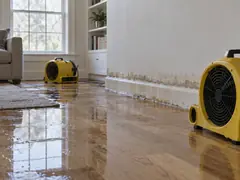
Air movers and dehumidifiers are billed per machine per day. Our calculator assumes 3 to 4 days for clean or gray water and 4 to 5 for sewage, plus a day if the water sat more than 48 hours.
-
Wet area
Extraction, tear-out and machine counts all grow with the square footage. About two rooms (400 sq ft) of gray water runs $2,200–$4,800; 1,000 sq ft runs $4,650–$9,850.
-
What has to come out
Wet carpet pad and drywall cut along the walls come out for gray water and sewage. Tearing out drywall runs $1.03–$2.26 per sq ft on published price sheets, before overhead and profit.
Water category moves the price most
- Category 1 Clean water Burst supply line, clean sink overflow $$$Lowest cost
- Category 2 Gray water Washing machine, dishwasher, aquarium $$$Higher cost
- Category 3 Black water Sewage, sewer backflow, floodwater from outside $$$Highest cost
Mitigation cost by situation
Each range is the calculator’s answer for drying and tear-out only, at national prices. Repairs come after.
-
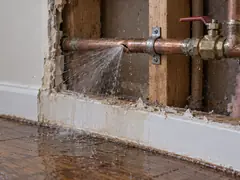 Clean water, caught earlyOne room, dried in place
$1,150–$2,750
Clean water, caught earlyOne room, dried in place
$1,150–$2,750
-
Gray water, one roomWashing machine or dishwasher overflow, 200 sq ft $1,500–$3,400
-
Gray water, about two rooms400 sq ft, carpet and drywall $2,200–$4,800
-
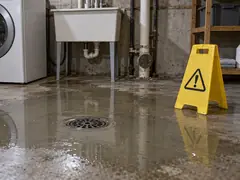 Sewage, one room200 sq ft, drywall cut 4 ft up
$2,200–$4,950
Sewage, one room200 sq ft, drywall cut 4 ft up
$2,200–$4,950
-
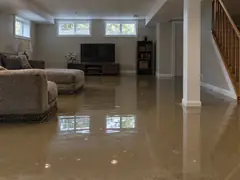 Finished basement800 sq ft, gray water
$3,950–$8,450
Finished basement800 sq ft, gray water
$3,950–$8,450
-
1,000 sq ft, gray waterSeveral rooms or a large basement $4,650–$9,850
Got a mitigation quote? Check it line by line
Mitigation bills grow by the day, so the daily moisture log is your best check. Upload your quote and we’ll check it line by line.
Water Damage Quote Checker
Upload a PDF or photos. Free, no sign-up.
No quote yet?
By uploading, you agree to our terms and confirm you have the right to share the quote. How we handle uploads
- Every line compared with price sheets near the job
- The questions to ask before you sign
- We never keep the file
Turn on JavaScript to upload a quote.
Reading your quote
- Reading every line
- Sorting drying, equipment and tear-out
- Getting it ready for you to check
We read 0 lines
Check them against your quote and fix anything we got wrong. Nothing is compared until you say it looks right.
When you check it, we keep these lines and the first three digits of the ZIP code to improve our ranges, never the file. Remove any names or addresses first. How we handle uploads
Ask before you sign
We compare drying prices with published price sheets and repair prices with typical local rates, adjusted for labor costs near the job. A line can be high for a good reason, like water hidden in a wall, so ask before you assume.
A fair quote shows
- Equipment by the day, matched to a daily moisture log
- The water category, and what it was based on
- Square footage for extraction, tear-out and antimicrobial
- Drying and tear-out priced apart from rebuilding
Red flags
- Being told you have to sign an assignment of benefits or a direction to pay
- Equipment days after the readings showed dry
- Pressure to sign before your insurer has seen the damage
Will insurance pay?
Usually, when the water damage itself is covered. Your policy expects you to protect the house from more damage, and pays reasonable costs to do it. Several states say plainly that you can pick the company.
Usually covered
- Reasonable drying and cleanup after a covered loss
- Temporary repairs that stop more damage, with receipts
- A mitigation company you choose, in many states
Usually not covered
- Charges your insurer decides were excessive or not needed
- Mitigation after flooding from outside, without flood insurance
- Mitigation for slow leaks or poor upkeep
Your policy wording decides.Does homeowners insurance cover water damage?
Before you sign a mitigation contract
-
1
Read the work authorization
Know who you’re hiring, what you’re authorizing and how much it will cost. Never sign a contract with blank spaces.
-
2
Don’t sign away your claim
You don’t have to sign an assignment of benefits to get the work done. It lets the company deal with your insurer and collect payment without you. Florida bars them on home policies issued or renewed since 2023.
-
3
Ask for the daily moisture log
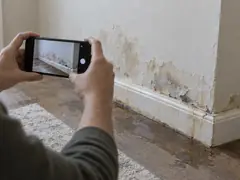
Readings from a moisture meter show when each area is dry. They’re what justifies each day of equipment on the bill.
-
4
Check the certification
Look the company up in the IICRC’s Global Locator. A certified firm employs at least one IICRC-certified technician.
Questions people ask
What is water mitigation?
It’s the work that stops water damage from getting worse: extracting the water, drying with fans and dehumidifiers, tearing out wet drywall and carpet that can’t be dried, and treating what’s left. Washington’s insurance commissioner calls these emergency actions to prevent additional damage. Fixing the leak itself is usually a plumber’s job, not the mitigation company’s.
What’s the difference between mitigation and restoration?
Mitigation stops the damage; restoration puts the house back with new drywall, paint, flooring and trim. They’re often billed separately, sometimes by different companies. On one 200 sq ft room with gray water, mitigation runs $1,500–$3,400 and repairs $2,150–$4,450.
How long does water mitigation take?
Usually 3 to 5 days of drying in our calculator, depending on how dirty the water was and how long it sat. The EPA says to dry wet areas within 24 to 48 hours to prevent mold, which is why mitigation starts right away, before repairs are even planned.
Do I have to use my insurance company’s mitigation company?
Usually not. Maryland’s insurance regulator says you have the right to choose the company you want, and that a referral doesn’t mean the charges will be covered. Washington says you can select your own contractor, and Louisiana law bars insurers from requiring a particular one.
What is an assignment of benefits?
A form that hands your insurance claim to the contractor, who then deals with your insurer and collects payment directly. You don’t need to sign one to get repairs done, the NAIC says. In Florida they’re barred on residential property policies issued or renewed on or after January 1, 2023, the state’s Department of Financial Services says.
Will insurance pay the whole mitigation bill?
Only the reasonable part, after your deductible. Maryland’s regulator warns that you may be responsible for charges your insurer finds excessive or not needed to properly mitigate the damage. That’s why the daily log and a line-by-line quote matter.
How we got these numbers
Drying prices come from 10 published price sheets. Repair prices are built from published labor hours, federal wage data for each trade and store prices for materials, then checked against public repair price sheets. Both are adjusted for labor costs near your ZIP. Ranges are national until you add one. Read the full methodology.
- Published restoration price sheets (state and county contracts, contractor price lists), RestoreCost.
- Beware of fraud after you suffer home or property damage, Washington Office of the Insurance Commissioner.
- Filing a homeowner insurance claim, Washington Office of the Insurance Commissioner.
- Mitigation companies: what consumers should know, Maryland Insurance Administration.
- Residential property claims guide, California Department of Insurance.
- Don’t Get Scammed After a Disaster, California Department of Insurance.
- La. R.S. 22:1892, Louisiana Legislature.
- Fla. Stat. 627.7152, assignment agreements, Florida Senate.
- Assignment of benefits, Florida Department of Financial Services.
- After a storm, read the fine print to avoid signing away your insurance benefits, NAIC.
- Homeowners 3 – Special Form (HO 00 03 10 00), sample policy, ISO, hosted by the Insurance Information Institute.
- ANSI/IICRC S500 Standard for Professional Water Damage Restoration, IICRC.
- Category of Water Damage and Weather-related Events (S500 position statement), IICRC.
- IICRC Global Locator, IICRC.
- Mold Remediation in Schools and Commercial Buildings, Chapter 3, U.S. EPA.
- A Brief Guide to Mold, Moisture and Your Home, U.S. EPA.